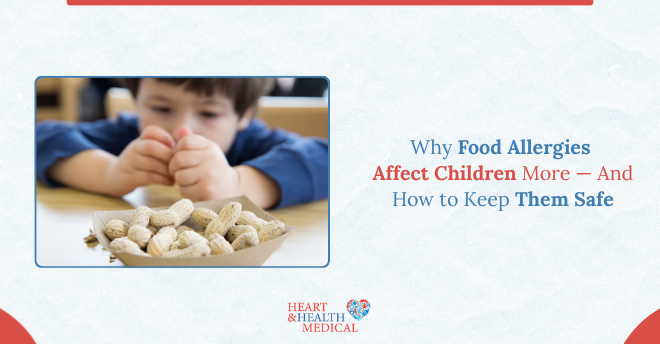
Food allergies are common in children and can be frightening for parents. Even a small amount of certain foods can trigger symptoms ranging from mild rashes to serious breathing problems.
At Heart & Health Medical, we help families understand, diagnose, and manage food allergies with expert Allergy & Immunology care across Long Island.
What Is a Food Allergy?
A food allergy occurs when the immune system mistakenly identifies a food as harmful and reacts against it.
These reactions can affect:
- Skin (hives, rashes)
- Digestive system (nausea, vomiting)
- Respiratory system (coughing, wheezing)
- Entire body (severe reactions like anaphylaxis)
Even trace amounts of an allergen can trigger symptoms in sensitive children.
Why Food Allergies Affect Kids More
Children are more vulnerable to food allergies because:
- Their immune systems are still developing
- Smaller body size can intensify reactions
- They may not recognize or communicate symptoms early
- Exposure often happens in school or social settings
Because of this, reactions in children can be faster and more severe—making early awareness critical.
Common Food Allergy Triggers in Children
The most frequent triggers include:
- Milk
- Eggs
- Peanuts
- Tree nuts (almonds, walnuts, etc.)
- Soy
- Wheat
- Fish
- Shellfish
Every child is different—some react to one food, others to multiple.
Warning Signs You Should Never Ignore
Symptoms can range from mild to life-threatening. Watch for:
- Hives or skin rash
- Swelling of lips, face, or eyes
- Stomach pain or vomiting
- Coughing or wheezing
- Trouble breathing
- Dizziness or weakness
Severe reactions (anaphylaxis) are medical emergencies and require immediate care.
How Food Allergies Are Diagnosed
Accurate diagnosis is essential for proper management.
Evaluation typically includes:
- Detailed medical history
- Symptom patterns and timing
- Family history of allergies
- Supervised allergy testing (e.g., skin testing)
At Heart & Health Medical, we use advanced diagnostic methods to identify exact triggers safely and precisely.
How to Manage Food Allergies
Management is personalized for each child and may include:
- Clear food avoidance guidelines
- Medication and emergency treatment plans
- Nutrition support
- Education on reading food labels
Our goal is long-term safety while maintaining a healthy, balanced lifestyle.
Allergy Action Plans for School & Activities
Children spend much of their time outside the home, so preparation is essential.
We provide customized Allergy Action Plans that include:
- Emergency instructions for schools and caregivers
- Medication usage guidelines
- Food safety protocols
This ensures fast, appropriate responses in case of exposure.
Managing Food Allergies at Home
Parents play a key role in prevention. Simple but effective steps include:
- Always reading food labels
- Separating safe and unsafe foods
- Avoiding cross-contamination in the kitchen
- Teaching children about their allergies
We guide families step-by-step so they feel confident managing daily life.
Conclusion
Food allergies can be serious—but with the right care, they are manageable.
At Heart & Health Medical, we provide:
- Expert allergy evaluation
- Advanced testing
- Personalized care plans
- Ongoing family support
We proudly serve communities across Long Island, including Plainview, Massapequa, North Babylon, and Coram.
Call: (516) 878-7899
Visit: www.heartandhealth.com
FAQs
Can food allergies be dangerous?
Yes. Some reactions can be severe and require immediate medical attention.
What should parents do if they suspect an allergy?
Stop the suspected food and seek medical evaluation as soon as possible.